James Bye relished the “fear” of being killed off during ‘EastEnders’ live episode.
The 41-year-old actor bowed out of his role as Martin Fowler last month after being crushed by a steel beam, and he admitted it was a “helluva responsibility” to take such a pivotal role in the 40th anniversary special but he agreed when executive producer Chris Clenshaw pitched the idea in September.
James told the Daily Mirror newspaper: “It felt a helluva responsibility to die in that way, not only on the soap’s 40th anniversary but live in front of the nation.
“I’m attracted to fear, so I agreed. I’d joined in 2014, so it had been 10 years, effectively all of my 30s, that I’d been on the show.
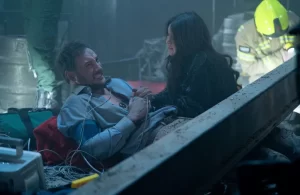
James thinks his departure was particularly “effective” because fans had expected either arsonist Reiss Colwell (Jonny Freeman) or Sonia Fowler (Natalie Cassidy) to perish.
He said: “Which is what made it so effective. The audience had always loved him and Stacey as a couple, through all their ups and downs. Suddenly, it looked like a happy-ever-after for them and then it was snatched away.”
James – who has Edward, 11, Louis, nine, Hugo, five, and 21-month-old Rufus with wife Victoria – still hasn’t watched the live episode back.
He said: “I just haven’t had the chance.”
And the actor is unsure he’ll tune in to Martin’s funeral because he thinks it would be “weird”.
He said: “I’m not sure I want to watch my own cremation, if that’s what it turns out to be. I won’t record it. But I might catch it when it’s on.
“If I’m honest, I’d find it a bit weird.”
James turned down a request from the show for his on-screen funeral.
He explained: “The art department were asking for pictures of me to put in the order of service. But I said no. I don’t want real photographs of me at my funeral, with my real family cut out.”

James Bye, the actor behind Walford’s most infamous bad boy Martin Fowler, has spoken candidly about the experience of filming the live episode of EastEnders, an event that was watched by over 12 million viewers and culminated in the shocking death of his character. The episode, which aired on February 23rd, 2017, was a landmark moment in British television history, marking the soap’s 30th anniversary and pushing the boundaries of live broadcasting. For Bye, however, the excitement and pride of being part of such a monumental occasion were tempered by a very real and palpable fear – the fear of getting it wrong, live, in front of a massive audience.
It’s a feeling most actors can only imagine, the weight of knowing that a single flub, a forgotten line, or a misplaced action can’t be edited out or re-shot. It’s a sensation akin to performing on stage in theatre, but amplified exponentially by the knowledge that your mistakes will be broadcast into the living rooms of millions of people, immortalized forever on television screens across the country. Bye recalls the weeks and months leading up to the live episode as a period of intense preparation, rehearsal, and, increasingly, anxiety. “As the day got closer, the fear started to creep in,” he admits in an interview, reflecting on the emotional state he found himself in. “It wasn’t fear of the live aspect in terms of ‘Oh no, I’m going to forget my lines’, it was more fear of the consequence of what we were doing. We were killing off my character, and that was a very real thing.”
For those unfamiliar with the storyline, Martin Fowler, a central character in the soap’s intricate web of relationships and dramas, had become embroiled in a bitter feud with his family over his involvement with a notorious gangland figure, Keanu Taylor, played by actor Danny Walters. The tension had been building for months, with the live episode promising – or threatening, depending on one’s perspective – a dramatic and violent confrontation that would see Martin meet his maker at the hands of Keanu, in one of the most shocking plot twists EastEnders had ever conceived. The significance of the event wasn’t lost on Bye; he knew that his character’s demise would send shockwaves through the show’s loyal fan base, many of whom had watched Martin grow from a rebellious teenager into a troubled but ultimately lovable adult. The pressure, therefore, wasn’t just about executing a technically flawless performance but about doing justice to the story, the character, and the audience’s emotional investment.
Bye’s journey with Martin Fowler began over a decade ago, when he first stepped onto the EastEnders set as a young, relatively new actor trying to make a name for himself in the cutthroat world of television. Over the years, he watched his character evolve, make mistakes, love deeply, and hurt those around him, all while navigating the soap’s trademark gritty realism and high-octane drama. Martin became, in many ways, an extension of Bye himself, a fictional persona so deeply ingrained in his psyche that distinguishing between actor and role sometimes became a blur. “You become so close to the character, you start to think like them, react like them,” Bye explains, highlighting the intense psychological immersion required to play such a complex figure. Thus, the announcement that Martin would be killed off wasn’t just a professional challenge; it was akin to being told a part of you had to die too.
The live episode was the brainchild of EastEnders’ then-executive producer, Sean O’Connor, who had a vision of pushing the soap into uncharted territory by combining its traditional narrative strengths with the unpredictability and immediacy of live television. The idea was met with a mix of excitement and trepidation by the cast. On one hand, the opportunity to be part of something so groundbreaking and historic was a once-in-a-lifetime chance; on the other, the very thought of performing without a safety net – no second takes, no do-overs – was daunting, to say the least. For Bye, the initial reaction was a jumbled mix of emotions: pride at being chosen for such a pivotal moment, sadness at saying goodbye to a character he’d grown to love, and, increasingly, fear. Not just fear of failing in the moment but fear of not doing Martin justice in his final scene.
As rehearsals intensified, Bye found himself consumed by the minutiae of every gesture, every line delivery, every breath. The scene in question had been meticulously scripted and storyboarded, with every actor’s move choreographed to the second. Yet, despite this precision, there was an inescapable truth: the live format meant embracing chaos. Anything could happen – a technical glitch, an unexpected reaction from a fellow actor, a simple lapse in concentration – and it would be visible to all. Bye likens the sensation to “being on the edge of a cliff, knowing you’re about to jump off, but not knowing if there’s actually a net below.” The weeks turned into days, and the days into hours, with Bye’s anxiety manifesting in physical ways: sleepless nights, loss of appetite, and an all-pervasive sense of dread that lingered long after he’d left the studio.
In an odd way, it was a conversation with a fellow cast member that became a turning point for Bye. “Someone said to me, ‘You know, Martin doesn’t care that he’s going to die. He knows it’s coming, he’s ready for it, and he’s going to go out on his terms.’” This simple yet profound insight shifted Bye’s perspective on the fear he’d been carrying. He realized that his fear wasn’t about the live aspect per se but about the emotional authenticity of the scene. Martin Fowler wasn’t just any character dying; he was a man who’d courted death his entire life, who’d lived hard, loved hard, and fought hard. His final moment wasn’t about the mechanics of dying (the stabbings, the blood, the dramatic music) but about the why – why Martin chose to stand his ground, why he accepted his fate with a mixture of defiance and resignation.
This realization allowed Bye to reframe his fear, to see it not as an enemy but as a catalyst. He began to channel his anxiety into the performance, using it to fuel a raw, visceral energy that felt truer to Martin’s spirit. The night of the live broadcast, as he stood in the Fowler’s living room set, surrounded by his on-screen family – Denise (Diane Parish), Arthur (Bill Treacher), and a grief-stricken Linda (Kellie Bright) – the fear didn’t vanish, but its nature changed. It became a heightened sense of awareness, a sharpened focus on the moment. Every glance, every word, every subtle shift in posture was imbued with a sense of purpose: this was Martin’s moment, and it had to count.
When the cameras rolled, and the episode went live, Bye felt a strange sense of calm wash over him. It was as if all the preparation, all the fear, and all the doubt coalesced into a singular, crystalline moment of clarity. The scene played out with a precision that belied its live nature – the fight, the struggle, Keanu’s knife rising and falling, Martin’s shocked realization, and then, the slow, inevitable collapse onto the floor. The aftermath was a blur. Bye remembers little of the immediate seconds following his character’s death, only that when he looked up, the set was silent, except for the sound of sniffling from some of the crew members. It was then that the enormity of what they’d just done hit him – they’d killed off a beloved character, live, on national television, and it had been real.
The reaction from viewers was immediate and overwhelming. Social media platforms crashed under the deluge of tweets and posts, many expressing shock, sadness, and, in some cases, anger at the show for ‘killing’ Martin. Over 12 million watched in the UK alone, with millions more streaming online. For Bye, waking up the next morning to this tidal wave of emotion was surreal. He’d expected a reaction, of course, but the scale of it – the vigils held outside the EastEnders studios, the tributes from fans, the heated debates on forums – underscored just how deeply Martin Fowler had burrowed into the British psyche.
In the months that followed, Bye struggled with the aftermath of the live episode in ways he hadn’t anticipated. On one hand, there was the professional vindication – accolades from peers, critical acclaim, and a newfound respect for his craft. On the other, there was a personal emptiness. Martin was gone, and with him, a huge part of Bye’s daily life vanished too. “It’s odd,” he reflects, “because you’re grieving for a character, but it’s a real grief. You’ve spent years of your life living as this person.” The adjustment wasn’t easy. Bye took time off, reconnected with family and friends, and slowly began to explore new projects outside the EastEnders bubble.
Looking back, Bye identifies the live episode as a watershed moment in his career, one that forced him to confront and ultimately harness his fear. “It taught me that fear isn’t something to be overcome; it’s something to be used,” he says thoughtfully. For an actor, the line between vulnerability and strength is thin, and the live episode of EastEnders was the ultimate test of that balance. By embracing his fear, rather than trying to suppress it, Bye delivered what many consider one of the greatest performances in soap history – a testament to the power of live television and the enduring legacy of Martin Fowler.
Today, when Bye steps onto a set or onto a stage, he carries with him the lessons of that night. Fear, he’s come to realize, is not the enemy of art but its silent partner. It’s the acknowledgment that what you’re doing matters, that the stakes are real, and that, sometimes, the most powerful performances are born in the moments when you’re scared to death – not of failing, but of succeeding, of touching something true and profound in the people watching.
In the years since that landmark episode, EastEnders has continued to push boundaries, experimenting with live formats and special events. But for James Bye, the memory of Martin Fowler’s death remains special – a reminder that, sometimes, it’s the fear of letting go that allows us to truly create something unforgettable. As he puts it succinctly, “That night, we didn’t just kill a character; we brought a piece of all of us to life, right there, on television.”
The legacy of the live episode endures, not just as a technical feat or a ratings success but as a moment when television, at its best, reminded us of its power to shock, to move, and to stay with us long after the credits roll. For James Bye, and for Martin Fowler, that’s a legacy worth embracing – fear and all.
News
BOMBSHELL ANNOUNCEMENT: Simone Biles and Jonathan Owens Reveal Surprise Pregnancy in Adorable Photoshoot – You Won’t Believe the Cute Way They Broke the News!
Olympic Gymnast Simone Biles and NFL Player Jonathan Owens: They Announce Their Pregnancy with a Heartwarming, Picture-Perfect Photoshoot Showcasing Biles’…
SHOCKING VIDEO: You Won’t Believe What Happens When Cops Discover Gene Hackman and Betsy Arakawa’s Bodies…
Gene Hackman and Betsy Arakawa deaths linked to hantavirus as bodycam footage reveals tragic home scene Police bodycam footage released…
Kim Kardashian BLASTED For Letting Daughter North West Go SOLO at Coachella—Fans Are Outraged!
Kim Kardashian shares her oldest child, North West, with her ex-husband, Kanye West Kim Kardashian has come under fire time…

Tom Brady & Gisele Bündchen Divorce BOMBSHELL—Did Football and Secret Rituals Tear Them Apart?
Shocking News:The Tom Brady and Gisele Bündchen Divorce: Unraveling the Role of Football, Rituals, and Speculation For over a decade,….See…
Whoopi Goldberg EXPLODES on ‘The View’—Rips Jason & Kylie Kelce for SHOCKINGLY Exploiting Newborn Daughter Finn Anna Kelce!
JUST IN: Whoopi Goldberg Slams Jason Kelce and Kylie Kelce on ‘The View’ in Fiery Rant, Accusing Them of Exploiting…

Gene Hackman and Betsy Arakawa’s Shocking Home Photos Exposed—You Won’t Believe the Horrific Conditions!
Gene Hackman and Betsy Arakawa’s cluttered, rat-infested home revealed in shocking new photos The Santa Fe County Sheriff’s Office…
End of content
No more pages to load