
Introduction
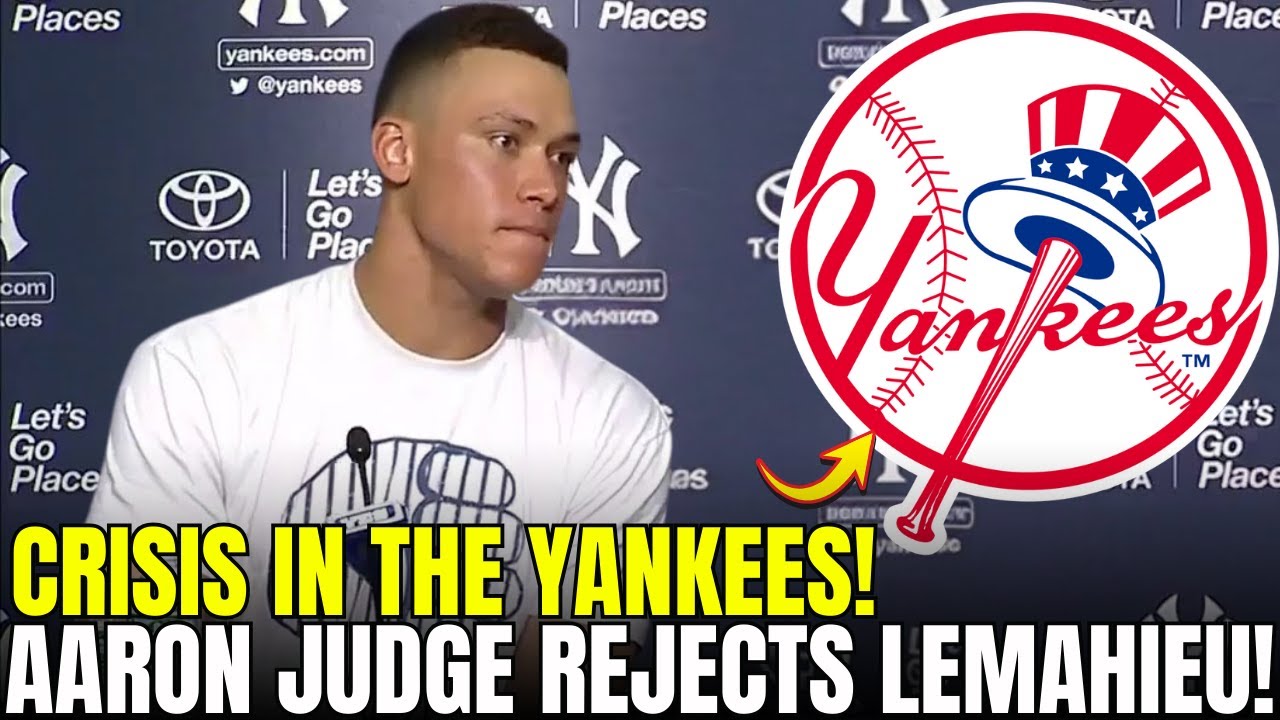
In a surprising turn of events, New York Yankees captain Aaron Judge made headlines by publicly declaring he would no longer play alongside veteran infielder D.J. LeMahieu. The statement, which reverberated through the sports world, has sparked intense speculation about its implications for the Yankees’ roster, team dynamics, and future strategy. While Judge’s comments could stem from a variety of factors—ranging from on-field performance to locker room tensions—the decision underscores the high-stakes environment of professional sports, where individual and collective success often dictates roster moves. This essay explores the potential motivations behind Judge’s declaration, the historical context of player influence in team decisions, and the broader impact on the Yankees as they navigate a critical juncture in their season.

The Weight of Leadership in Professional Sports
Aaron Judge, the Yankees’ longtime captain and face of the franchise, wields significant influence within the organization. His leadership extends beyond his role as an outfielder; he embodies the team’s legacy and competitive ethos. Judge’s decision to distance himself from LeMahieu, a respected veteran and former batting champion, raises questions about the balance between individual preferences and organizational strategy. Historically, star players have occasionally shaped team decisions, such as when Michael Jordan pressured the Chicago Bulls to trade for Scottie Pippen or when LeBron James’ free agency moves reshaped the NBA landscape. In baseball, while player-driven trades are less common, examples like Bryce Harper’s reported influence on the Philadelphia Phillies’ acquisitions highlight the growing trend of athlete empowerment. Judge’s stance could signal a shift in how MLB teams prioritize locker room cohesion and star-player input.
Potential Motivations Behind Judge’s Decision
Several factors could explain Judge’s reluctance to play with LeMahieu. On-field performance is a primary consideration: LeMahieu, once a consistent hitter, has struggled with injuries and declining production in recent seasons. Judge, as a leader, might perceive LeMahieu’s diminished contributions as a hindrance to the team’s playoff aspirations. Alternatively, defensive alignment could play a role. LeMahieu, primarily a third baseman and second baseman, might clash with Judge’s positional needs, particularly if the Yankees seek to experiment with younger players or optimize their lineup.
Another angle is interpersonal dynamics. While both players have been praised for their professionalism, prolonged struggles can strain relationships. If Judge perceives LeMahieu as a distraction or a negative influence, his declaration could reflect a desire to protect team morale. Additionally, contractual considerations might loom large. LeMahieu’s seven-year, $90 million contract, signed in 2021, becomes increasingly burdensome if his performance declines. Judge’s statement could pressure the front office to explore trades, leveraging his leadership to align roster decisions with competitive goals.
The Yankees’ Organizational Response
The Yankees’ management now faces a delicate balancing act. Publicly addressing Judge’s comments, General Manager Brian Cashman must navigate between respecting a captain’s input and maintaining flexibility. The organization’s immediate options include trading LeMahieu to clear salary space, demoting him to a bench role, or absorbing the financial hit to preserve team unity. However, trading LeMahieu would require the Yankees to take on a significant portion of his contract, limiting their ability to pursue other upgrades. Alternatively, designating him for assignment could alienate Judge and other veterans, undermining the clubhouse culture Cashman has worked to cultivate.
Historically, the Yankees have not shied away from bold moves—recall the 2004 trade of Johnny Damon to Oakland despite his popularity. Yet Judge’s unique status as a homegrown superstar complicates this scenario. His leadership is invaluable, and dismissing his concerns risks destabilizing the team’s identity. The front office may opt for a compromise, such as reducing LeMahieu’s playing time while exploring creative ways to utilize his versatility, including a potential shift to first base or designated hitter.
Broader Implications for Team Dynamics
Judge’s declaration could have ripple effects beyond LeMahieu’s future. It sets a precedent where star players exert greater influence over roster construction, potentially disrupting the traditional hierarchy between athletes and management. Younger players might interpret this as a sign that vocalizing dissent can yield results, while veterans could feel pressured to align with the team’s marquee stars. The situation also highlights the tension between meritocracy and loyalty. LeMahieu, a key contributor during the Yankees’ 2020 and 2021 playoff runs, deserves consideration for his past contributions, but his current performance may not justify a starting role.
Moreover, the media frenzy surrounding Judge’s comments risks becoming a distraction. The Yankees, accustomed to intense scrutiny, must now manage narratives about internal discord while maintaining focus on their World Series ambitions. A misstep could fracture team chemistry, particularly if LeMahieu’s reduced role breeds resentment or if Judge’s authority is perceived as overreach.
Historical Context and Precedent
Player-driven roster decisions are not unprecedented in MLB. In 2013, the Los Angeles Dodgers traded for Robinson Canó after he reportedly lobbied for the move, though the experiment quickly unraveled. More recently, the Houston Astros’ acquisition of Justin Verlander in 2017, influenced by his desire for a veteran presence, paid dividends in their championship run. These examples suggest that while player input can be beneficial, it carries risks. The Yankees must weigh the potential upside of accommodating Judge against the possibility of setting a problematic precedent or overcommitting to a declining player.
The Path Forward
For the Yankees, the immediate priority is to stabilize the situation. Open dialogue between Judge, LeMahieu, and management could mitigate tensions and clarify expectations. If LeMahieu accepts a reduced role, the team might retain his veteran presence without overextending his workload. Alternatively, a trade could free up resources for a more impactful acquisition, though finding a taker for LeMahieu’s contract remains challenging. The team’s performance in the coming weeks will also influence decisions; a winning streak might alleviate pressure, while a slump could accelerate the need for change.
Conclusion
Aaron Judge’s declaration transcends a simple player preference; it reflects the evolving dynamics of modern sports, where star athletes increasingly shape team strategies. While the Yankees’ response will hinge on balancing respect for leadership with pragmatic decision-making, the situation underscores the complexities of managing a high-profile franchise. Whether this moment becomes a turning point for the Yankees or a footnote in their season depends on how gracefully they navigate the intersection of individual influence and collective ambition. As the team strives to reclaim its championship pedigree, the handling of Judge and LeMahieu will serve as a litmus test for their resilience and vision.
News

NEW YORK GIANTS: Star Rookie WR Malik Nabers, doesnt like the current QB Room. “Thought we were taking this offseason seriously” -Malik Nabers After NY Giants signed QB’s Russell Wilson and Jameis Winston ahead of 2025 NFL Draft.
Malik Nabers and the Giants’ Quarterback Controversy: A Look at the Current Situation The New York Giants have always been…

BREAKING NEWS: Dak Prescott makes controversial statement after leaving Cowboys: ‘They don’t value me here, I’m gonna…’
Dallas, TX – The NFL world was rocked early this morning, March 22, 2025, when Dallas Cowboys quarterback Dak Prescott…

Yankees SHOCK Baseball World with Manny Machado ACQUISITION!
The New York Yankees have sent shockwaves throughout the baseball world with the stunning announcement that they have acquired Manny…

BASEBALL EARTHQUAKE: Francisco Lindor ABANDONS Mets for $341 MILLION Yankees contract
BASEBALL EARTHQUAKE: Francisco Lindor ABANDONS Mets for $341 MILLION Yankees contract – The End of an Era in Queens In…

UNPRECEDENTED GRIEF: The GREATEST LOSS in New York Yankees history JUST HAPPENED
The New York Yankees’ Pitching Crisis: A Season Hanging in the Balance The New York Yankees, one of Major League…

CONTRACT FINALIZED: Manny Machado SIGNS THREE-YEAR DEAL with Yankee
CONTRACT FINALIZED: Manny Machado SIGNS THREE-YEAR DEAL with Yankees – A Seismic Shift in the MLB Landscape In a move…
End of content
No more pages to load